
Hey People 👋!
This is the story of a Wealthy King called Peter and his Compounding Dues which he cannot pay no matter what. Peter’s associate was granted a wish and this is how the conversation went (in simple words)
Peter: Wish something and I will grant it.
Associate: Give me rice grains by doing this.
- Take a chessboard and place one rice grain in the first square.
- Double it in the next square and continue till the 64th square.
Peter: Ya okay, whatever I’m the King!
Peter’s Minister: Damit!
The math was started, a chess board was brought and the exercise was initiated.
- One grain
- Two grains
- Four grains
and continued till the 15th square, everyone except the minister and the Associate were laughing out loud.
- 16,384 grains
Here, everyone is noticing something odd. Associate starts smiling.
- 5,24,288 grains
By the time it reaches the 20th square, the entire court-room is silent and even king’s confidence dropped.
- 2 Billion rice grains
Just halfway across the board, every rice grain in his kingdom is collected and kept for this exercise. Now the king has to fill the other squares, waging wars against his fellow kingdoms.
Square 40: Nearly 1 Trillion rice grains
Square 50: Nearly 1 Quadrillion rice grains
Last Square (64): 9,223,372,036,854,775,808 rice grains, which is 9.22 Quintillion Rice Grains
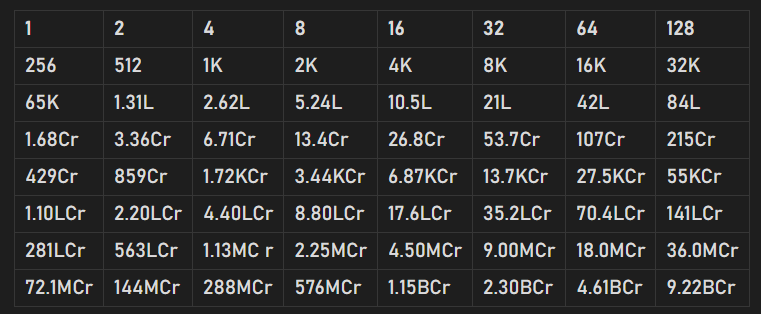
And the realistic number is Square 25, meaning the King can give about 600 million rice grains and cannot afford more.
This is a classic Compound Interest example in which, rice grains are compounded for every square at 100%.
Compound Interest simply means, Interest on both Principal and Interest. Look at the following image, it shows the difference between simple and compound interests for ₹1000 at 10% interest per annum.
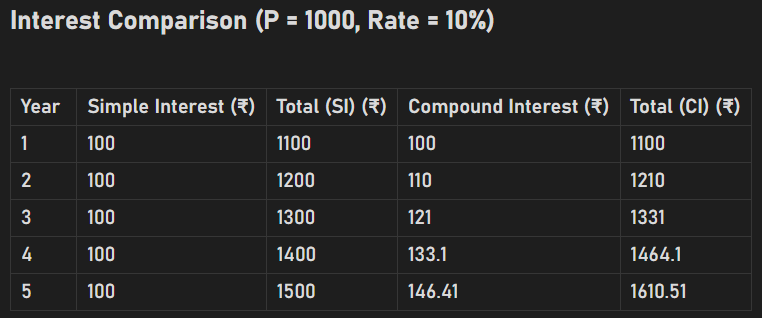
This is similar to the above given King’s Story and the only difference is, in King’s case, the Interest rate was 100% per square block and here, its 10% per annum.